
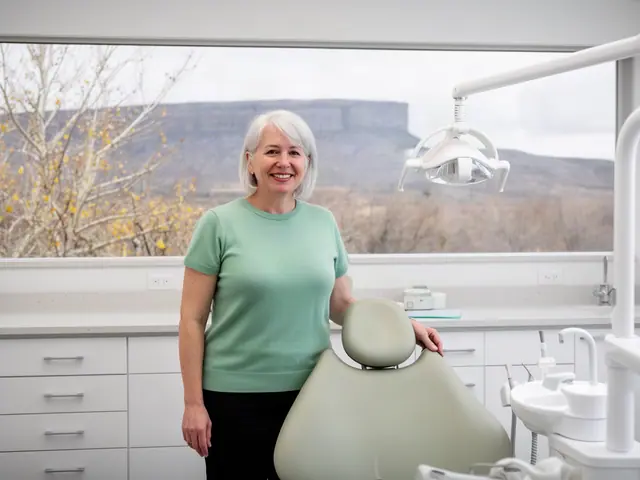
Dental funding requests from Montrose, Colorado reach funding partners through Canyonmoor Lending Group. The Census counted 27 employer dental offices in Montrose County, CO for 2023. This page covers dental practice loans, dental equipment loans, an acquisition checklist, working capital for insurance delays, financing agreements and cash flow projections.
At a glance
- Dental offices, Montrose County, CO
27, 237 employees (County Business Patterns 2023)
- Annual payroll, dental offices
$11.9 million (County Business Patterns 2023)
- Dental offices, the city's main postal ZIP
26 (ZIP Code Business Patterns 2023)
Dental Practice Loans for General and Specialty Dentists in Montrose County, CO
Dental office loans in Montrose, CO serve a group of 27 employer establishments in Montrose County, CO, which had 237 employees and $11.9 million in annual payroll in 2023, about $50,363 per employee (our arithmetic; County Business Patterns 2023). Only 37.0% had fewer than five employees, so a typical office carries a hygienist, assistants and front-desk staff.
Dental practice loans fall into three groups: equipment for operatories and imaging, a term loan to buy or expand a practice, and a line or working capital for the gap between treatment and insurance payment. Each is read on its own purpose.
Dental Equipment Loans for Groups Adding Operatories
Illustration only, invented figures: an office adds 2 operatories with chairs and delivery units at $32,000 each and a $98,000 cone-beam CT, $162,000 in all (our sum). Spread over 84 months at an invented 10% a year, that works out to about $2,689 monthly (our arithmetic). The equipment secures the loan.
Ask whether installation, plumbing and cabinetry can be included, and whether the imaging software license is financed or billed separately. The equipment page compares leases and loans.
Dental Practice Acquisition Checklist for a Buying Dentist
- The practice's returns and collections reports for the past three years.
- An equipment list with ages, and the condition of each operatory.
- The lease, with assignment terms and years remaining.
- Active patient count and the payer mix.
- A transition agreement with the selling dentist, if any.
Illustration only, invented figures: a $480,000 practice purchase with $48,000 down, financed over 120 months at an invented annual rate of 9%, costs about $5,472 a month (our arithmetic). The term loan page covers acquisition financing in more depth.
Working Capital for a Dentist Buying a Practice in Montrose County, CO
A new owner pays staff, supplies and the lease from the first day, while the first months' insurance payments are still in process. A working capital loan or a line sized to that ramp-up keeps the transition steady. Partners read the seller's collections pattern to estimate how long the gap lasts.
Dental Office Working Capital Requirements: Insurance Payments and Payroll
Illustration only, invented figures: an office bills $74,000 a month to insurers and waits 40 days on average, so about $98,667 sits in claims at any time (our arithmetic). A line of credit sized to that gap carries payroll until claims pay.
Offices that track claims by payer and age can show a partner when money arrives; those that do not can pull an aging report from their practice software before the request.
Intraoral Scanners and Cone-Beam CT: Lease or Buy for a Dental Office
Imaging and scanning equipment changes faster than chairs and cabinetry. An office that expects to upgrade a scanner within a few years can lease it and return it, while an office that keeps a cone-beam CT for its full life can finance it and own it when the payments end. Partners read the quote, the software and service contracts, and how often the office bills for the procedures the equipment supports.
Put the lease total, including any buyout, beside the loan total over the same period. A tax preparer can explain how each structure is treated; the funding choice rests on cash flow and on how long the office plans to keep the unit.
Dental Office Financing Agreement: Clauses to Read
- The equipment or practice assets named as collateral.
- Any personal guarantee and how far it reaches.
- Prepayment terms, in case the practice is sold or refinanced.
- Insurance requirements on financed equipment.
- Default triggers, such as a change of ownership or location.
Dental Practice Cash Flow Projection Before a Large Purchase
A projection starts from collections, not production. List expected monthly collections, subtract payroll, supplies, lab fees, rent and current debt, then add the new payment. If the leanest projected month still covers everything, the purchase fits. Dental offices with a ZIP 81401 address counted 26 in 2023 (ZIP Code Business Patterns 2023), and Nonemployer Statistics counted 4 dental offices without paid employees for 2024 (Nonemployer Statistics 2024).
Working Capital for Dental Insurance Delays and Fee Schedule Changes
When an insurer changes its fee schedule or slows payment, collections drop before the office can adjust. A line held for that gap, drawn only when needed, costs little when idle beyond any annual fee. Patient financing for treatment plans is a separate product for patients; this site arranges funding for the practice itself.
By Canyonmoor Lending Group · Updated